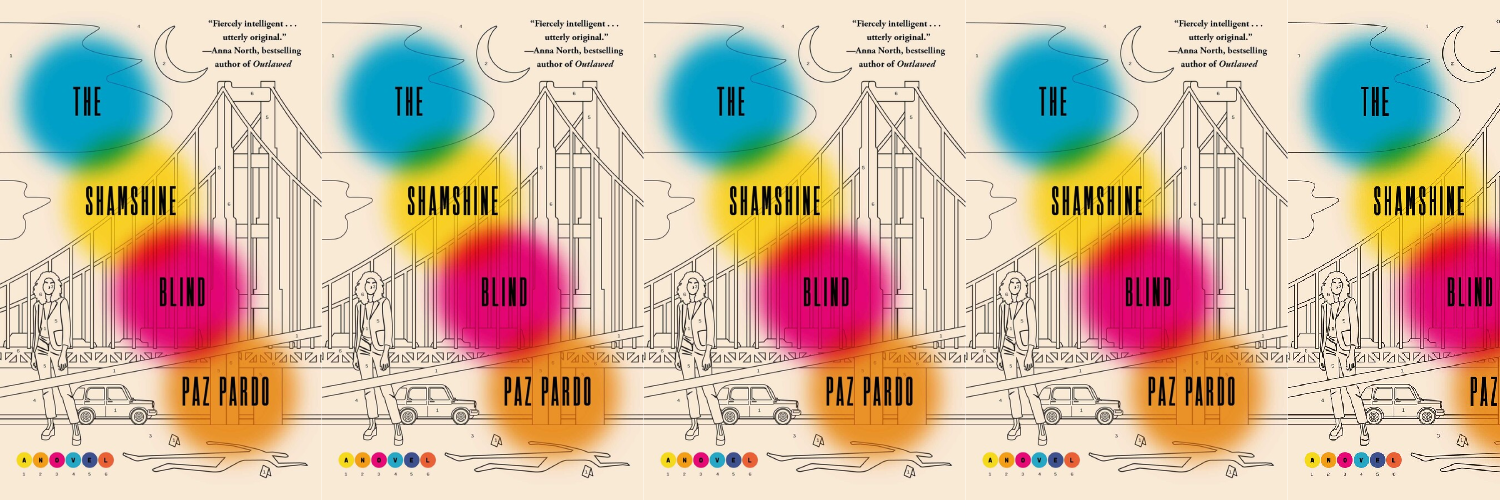
On Hope Depletion and Colourful Noir: The Shamshine Blind by Paz Pardo
The Shamshine Blind by Paz Pardo is a book that sneakily lures you in with its hardboiled detective and its bucketloads of atmosphere and its fascinating alternate history (not to mention its page-turning plot). And then, wham. Before you know it, you are in the middle of a story that is actually about collective and individual hope and despair — which feels awfully resonant with real life.
The Shamshine Blind is smart and funny and has underpinnings of deep sadness that hit me right where it hurt. And I mean that in the best kind of way.
The year is 2009, and our protagonist, Agent Kay Curtida, lives and works in Daly City, now a backwater on the outskirts of the ruined and abandoned city that was once San Francisco. In this universe, the course of history took a sharp turn in 1982, during the Falklands War. World powers fell to their knees in surrender to Argentina, which had developed and deployed a new chemical weapon—psychopigment. Brightly coloured chemicals with the ability to induce emotion upon contact, psychopigments changed everything.
Now, 27 years later, the US is no longer a prosperous and influential country, and it has dealt with this blow by assimilating psychopigments into its society and adapting them for profit. Pigments such as Sunshine Yellow, which induces happiness, have pharmaceutical uses. Deepest Blue, which erases memory, and Cloud Grey Listlessness are shot from guns instead of bullets. Magenta, which brings on temporary obsession, is used recreationally. And so forth. As you might expect, pigments are heavily regulated, but there is a roaring black market trade.
Curtida is an agent in Psychopigment Enforcement, and the story kicks off when she and her rookie partner Tommy are assigned to investigate a case of “Shamshine,” a dangerous knockoff Sunshine Yellow pigment. But things are never as simple as they seem in noir novels, and this one knows its tropes. Before long Curtida is mixed up not only with a Shamshine case, but also with a fanatical cult, a shady pharmaceutical company, an ex-lover, a missing scientist, and tantalizing clues that keep pointing towards the rarest and most elusive pigment of all: Lavender Hope.
In the world of The Shamshine Blind, hope is thin on the ground. “Global Hope Depletion Events” have sapped the emotion from the world, and the news media provides a daily “Hope Count,” always low. Since the development of recipes for psychopigment relies on extracting the true emotion from a large enough group of people who are feeling it in sufficient quantities, hope has become impossible to synthesize. Add to this the fact that Psychopigment Enforcement recruits on the basis of neuroprofiles, and hires only people they term “Depressives,” and you have a book full of characters who are teetering on the edge of despondency. In a world where your emotions are just as likely to have come from something external as internal, navigating your feelings is a wild ride.
None of this is to say that The Shamshine Blind isn’t a fun read — it absolutely is. The plot comes thick and fast, and Curtida’s first-person narration nails the shrewd, smart-alecky, but deep-down damaged and vulnerable voice that you want in a noir detective. The side characters, no matter how minor, are all terrifically developed and real. The setting of run-down cities and dismal weather provides the ideal atmosphere for the cast of corrupt kingpins and down-on-their-luck pawns.
But Paz Pardo flips a lot of noir tropes on their heads as well. Yes, there is loss, and trauma, and violence; yes, there are sleazy streets and underworld haunts. But Curtida is backed up by a solid crew of allies, to the point that I am tempted to say this book features her acceptance of her place in a found family. There is some moral ambiguity, but not with our main heroes—we do not have cause to doubt them. There are no femme fatales in sight (thankfully, Pardo’s characters are far too nuanced for that particular tired trope). And the externalization of emotions into bright and vivid colours is perhaps the best and most inventive riff on noir, which, as its name signals, is typically characterized by imagery of darkness and shadow.
The book includes a lot of exposition, especially in the first third or so of the story. But I’m going to give it a pass on that, because the world that Pardo has conjured requires a fair amount of explanation. A set up this detailed is a tough thing to work in seamlessly (just ask Tolkein), but in this case the backstory is not only worth it, but interesting in its own right. Yes, please, tell me where and when and how psychopigments came to be and how hope is measured in the atmosphere. I want to know!
Finally, the thing that really captured me was that The Shamshine Blind tells a story about the ways that grief and hopelessness intersect. As I continue to ache from my own losses in the past few years, as I keep watching the news and feeling despair about life and the world, reading Agent Curtida’s emotional processing struck something tender in me. Her history of loss and grief is woven into this story, along with her certain knowledge that most agents don’t make it much past middle age. Her memories take her back to studying poetry in school: “To fill a Gap/ Insert the Thing that caused it—/ Block it up/ With Other—and ‘twill yawn the more—/ You cannot solder an Abyss/ With Air.” [Emily Dickinson]
The story doesn’t shy away from hard emotions and difficult questions. At the same time, it’s a gripping yarn of a detective story filled with action, twists and turns, wonderful characters, and exceptional worldbuilding. It ties its multiple threads up in a highly satisfying way, and it contains all the details you need to envision a painted world just a little slant from our own. If you are a fan of speculative fiction, detective stories, noir, or alternate history, you will want to get your hands on this one.
Comments