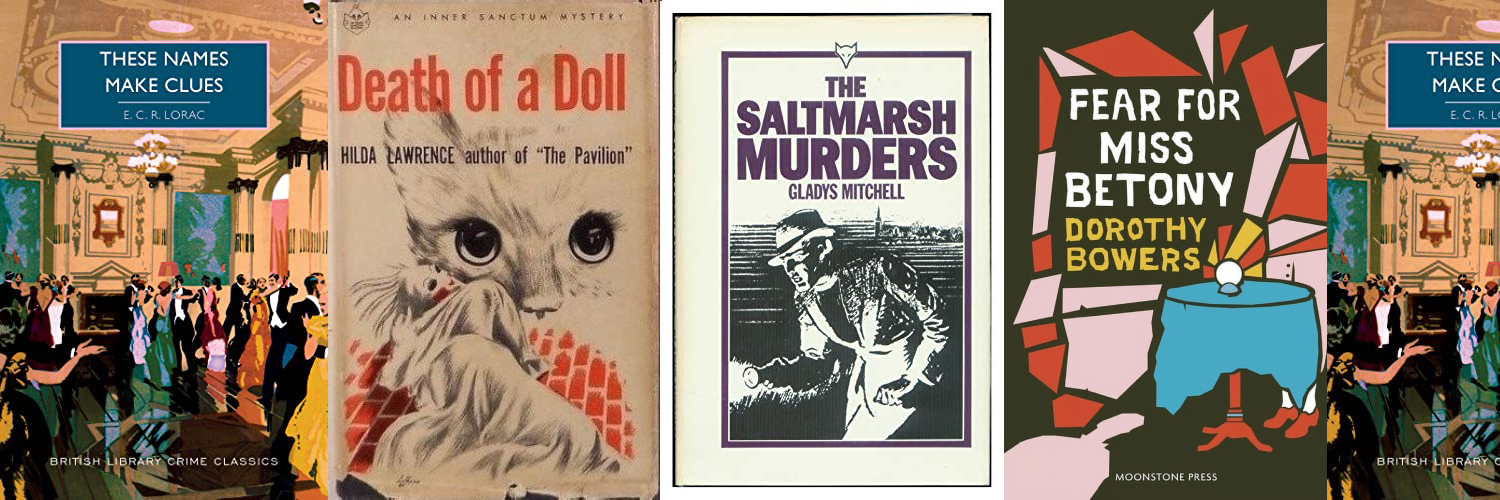
A Few More Golden Ladies
If you read this blog, you might know that I love a good Golden Age detective novel (particularly if it happened to be penned by Dorothy L. Sayers or Margery Allingham). A little while ago I discovered the excellent podcast Shedunnit, in which the creator and host Caroline Crampton “unravels the mysteries behind classic detective stories.”
For anyone who loves mysteries, this podcast is a lot of fun. In between its biographical episodes on Golden Age authors and its interrogation of recurring themes (country houses, apothecaries, poison pens, vicars), Shedunnit tells fascinating stories of some of the true crimes of the age that inspired and influenced writers of detective fiction.
While working my way through the podcast’s archives, I was inspired to seek out books by some of the lesser known women writing in this era. It may not surprise you to learn that the results were mixed. Dare I say that there is a reason why many of these writers remained lesser known? But, having said that, there have been some gems.
Without further ado, here are my takes on some of the more unsung Golden Ladies.
Dorothy Bowers, Fear for Miss Betony, 1941 (alternate title Fear and Miss Betony)
Okay, I’m getting this one out of the way first. Dorothy Bowers was the writer I was most excited to read, because a guest on the podcast expressed their opinion that, had she written more than five books (that’s still a lot!), her skill was such that she would have joined the ranks of Dorothy L. Sayers. (Instead, she mysteriously vanished, very à propos.)
Um. Hard disagree.
Now, in fairness, I did not read all five of Bowers’s books—I only read this one. And that is for a very good reason, which is that I ended up wanting to throw it in the bin.
Fear for Miss Betony started out fairly promising. Our protagonist, Miss Betony, receives a letter from an old pupil who now runs a boarding school in the country, begging her old friend to join her there, because something “formless and frightening” is happening. And so Miss Betony shuffles off to Makeways to investigate and to help.
As a character, Emma Betony combines the unfortunate qualities of being both bitter and weak. While I pitied her, I did not particularly enjoy following her story. Other aspects of the story seemed cheap to me—the villains are a little too villainous, the explanations a little too unbelievable, the commentary a little too supercilious. And the climax of the entire story takes place off the page, while Miss Betony is unconscious, and is related to us later by an extremely minor police officer character. From a storytelling perspective, this is simply unforgivable.
This book felt like it was trying very hard to say something profound but not quite managing it. Perhaps one day I will revisit Dorothy Bowers, but in my opinion, this one does not recommend her.
E.C.R. Lorac, These Names Make Clues, 1937
E.C.R. Lorac is one of several pen names used by the prolific author Edith Caroline Rivett. And I do mean prolific: between 1931 and 1959, she wrote 46 novels (!!!) featuring her sleuth, DI Robert MacDonald. She also wrote two other series under the pseudonym Carol Carnac: the Inspector Ryvet books (6 titles) and the Julian Rivers books (15 titles), as well as three standalone novels as Carol Rivett and one as Mary Le Bourne. One wonders when she had time to eat and sleep.
I started in on this impressive catalogue with the 1937 title These Names Make Clues, and I was pleasantly surprised by how much I enjoyed it. In fact, I enjoyed it so much that I went on to read Post After Post-Mortem (1936), Bats in the Belfry, (1937), and Murder in the Mill-Race (1952).
E.C.R. Lorac is excellent with characters. Each book has a large cast of believable, distinct, and nuanced people. There is also some lovely descriptive writing, and thoughtful insights into human nature. I appreciated the eye she clearly had for absurdity—both in people and in situations—and the terrific banter between DI MacDonald and his sidekick, Reeves.
The books occasionally suffer from a fragmented POV that hops around willy-nilly between characters, making the narrative feel disjointed at times. You’ll be following MacDonald along on his investigation and then all of a sudden you are getting up to a bunch of shenanigans with a journalist as he trails suspects through the countryside, for example. Perhaps for this reason, MacDonald himself is not explored as fully as he could be, which seems a shame. But if you can just roll with it all, you will probably have a pretty good time.
E.C.R. Lorac stands out as my favourite of these new-to-me Golden Age authors. What a good thing that I won’t be running out of her books anytime soon.
Gladys Mitchell, The Saltmarsh Murders, 1932
Well. Well, well, well. Of these authors, Gladys Mitchell is probably the most well known due to the BBC adaptation of her series, which is titled The Mrs. Bradley Mysteries. If you had an image in your mind of Mrs. Bradley as portrayed by Dame Diana Rigg—elegant, poised, admired—then you can set that aside right now. Mitchell’s Mrs. Bradley is a leering, cackling, terror-inducing woman who is constantly poking people and emitting an “eldritch screech of laughter.”

As far as the mystery goes, it was one of the nastier ones I have read. I suppose it is to be expected that in a book written in the early 1930s where the detective bases her deductions on psychology, it will inevitably be problematic. But this book was simply bursting with the outdated and the offensive: overt racism, sexism, misogyny, normalization of domestic abuse, even casual incest that Mrs. Bradley herself thinks is just fine, thanks.
Despite all of that, the writing style is quite lively, and the narrator of this story—a young curate named Noel Wells—has a charming and often funny voice. Still, I’m not tripping over myself to read more Gladys Mitchell.
Hilda Lawrence, Death of a Doll, 1947
This one may be pushing the limits of what can be considered “Golden Age,” since it was published in 1947, but I'm including it anyway. It was an interesting read, very different from your typical murder mystery and somewhat uneven, but enjoyable in its own way.
I'm a sucker for books set in dormitories, boarding houses, or hostels, and so this one pulled me in, being set primarily in the fictional Hope House, a lodging house for girls in New York City. This one features four—count ‘em, four!—detectives. Although this is billed as “A Mark East Mystery,” our man Mark (a private investigator) and his slightly more slow-witted foil Detective Foy are roundly upstaged by a sleuthing duo of elderly spinsters: Beulah and Bessy, who steal the show.
The tone of this book is quite a bit darker than the others, making it more of a sinister suspense novel than a classic whodunit. But then, interspersed with the ominous vibes at Hope House, come scenes with Beulah and Bessy that would not be out of place in a P. G. Wodehouse novel. It is a bit jarring, but both elements have their pleasures. There are also a plethora of POV characters, some of them warranting only a page or two. Given the setting in the lodging house, I think this could have worked well if it had been done with a little more consistency and deliberation. There was something deliciously unsettling about getting snatches of thoughts from a series of girls and not knowing who was in danger and who was dangerous.
Death of a Doll is a strange reading experience but one I would still recommend. Its vibes are sort of Gaudy Night + Picnic at Hanging Rock + Jeeves and Wooster. I’m definitely going to be reading more Hilda Lawrence.
Comments