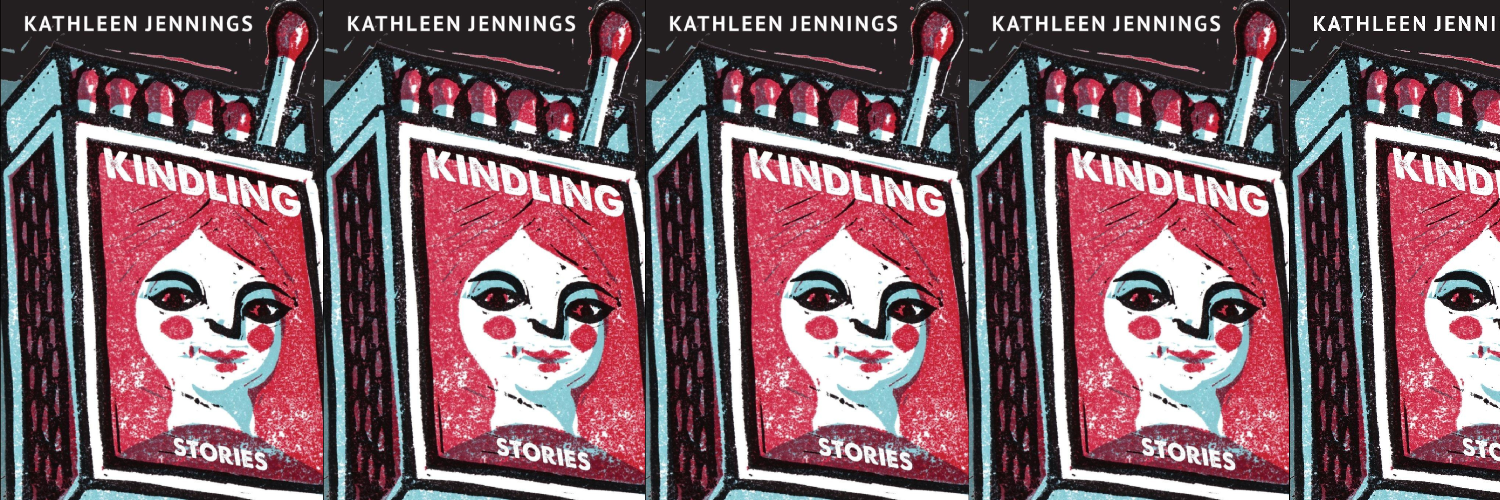
In Praise of Kathleen Jennings: Five Things to Steal from Kindling
Do you know the work of Kathleen Jennings? If by chance you do not, I am herewith going to fix that for you. Read on, friend, and don’t look back.
Kathleen Jennings is a hugely talented author and illustrator whose recent book of short stories, Kindling, came out at the end of last month. She is also a prolific writer of blog posts: her frequently updated website is absolutely jam-packed with musings, sketches, journal excerpts that unpack her creative processes, and a metric tonne of original writing and art exercises.
For a while I was stumbling across Kathleen Jennings everywhere. I discovered her exquisite Australian Gothic debut novel, Flyaway, and devoured it. Then I fell into the rabbit hole of her website, Tanaudel and started playing around with her writing and art exercises. Only then did I connect her with the intricate papercut and charming pen & ink illustrations that were adorning some of my favourites (“Waters of Versailles” by Kelly Robson, The River Bank by Kij Johnson, Ellen Kushner’s Tremontaine).
I cannot yell loudly enough about how much I love and am in awe of the work that Kathleen Jennings shares on Tanaudel. The sheer volume and density of the content is extraordinary—but beyond that, it is an amazing fusion of the creative impulse and the intellectual urge to pull it apart to see how it works. It is tremendously helpful for those of us who share these two longings but aren’t always sure how to get them to play nicely together. (I am particularly fond of one exercise that she calls “The Caudwell Manouevre”; I am equally as fond of the author Sarah Caudwell, in whose honour it is named.)
In her Observation Journal, one of the things Kathleen Jennings does is deconstruct inspiration. She has a recurring feature called “Five Things to Steal” in which she analyzes elements of media (or even just locations, such as a specific café) that she has enjoyed and ponders how to turn them to her own uses.
So in this mood of admiration with a touch of glee, here are my Five Things to Steal from Kindling:
1. An uneasy relationship with fairy tales. This book is billed as “folk tales and fantasies,” and it certainly draws on tropes and images and characters from fairy tales. But there is always a thread of something different woven into what might have been familiar shapes. In “A Hedge of Yellow Roses,” the maiden who is awaiting a prince from inside an enchanted house doesn’t know that outside, a revolution has happened. If a prince still existed, he could not dare to claim his blood. (And where does that leave our maiden? Why, slowly turning into a bird, of course [see #5]). “Undine Love,” the young warden of a magical boundary also runs a bed & breakfast, and when a guest accidentally summons a monster, she bumbles her way through the situation, not quite embracing her status as heroine but rather calling her parents, laying on the floor in despair, and sticking her foot in her mouth. Even the fairy tale monsters are not at ease: in “On Pepper Creek,” a boggart accompanies its family when they emigrate but has no time to torment them—it is too busy stressing out about the older, scarier monsters that threaten them in their new home. These little twists and transformations make the stories in Kindling spark with their own light and life.
2. Outlandish names. Also, terribly ordinary names. Kismet. Bright Seabrown. Jack. Brenda. Ariadne Winter. Curdie Caperwit. Tori Damson. Annie Coal. Excelsior. Moon. Mary. I have a thing for character names, and these hit the spot. They are a mixture of the fabulous and the familiar; grounding, yet expansive. Scope for the imagination, plus tendrils of relatability. A++, no notes.
3. The theme of home (and, conversely, the theme of adventuring). There is no story in this collection that does not invoke the idea of home. Some are exiled from it, some are building it for themselves. Some are trying to return to it. Many of our protagonists are adventurers, be it by choice or by necessity, and there is a certain mood to this, a combination of liveliness and resilience. But I confess that my favourite part of adventuring is coming home. One of my favourite stories in Kindling is “Annie Coal,” and the bookends of this story, when Annie is in her cottage on the hillside, filled me with such a nostalgic sense of home that I wanted to climb right into the pages. Annie longs for adventure, but she has roots that will always lead her back home. Similarly, in one of my other favourites, “Skull and Hyssop,” Captain Moon thinks he has found a home on his beloved airship, but he is forced to reckon with how far he will let his complicity take him, and what it might look like to start rebuilding his home from scratch. In these tales we don’t always have comfort or a happy landing, but we do have the chance to wonder—what and where is home, anyway?
4. Glorious metaphors and similes. Is it even a Kathleen Jennings story if it’s not brimming with beautiful language? (No, it’s not.) One of the things I think she does so beautifully is, to paraphrase the writer Shaelin Bishop, take an abstract concept or feeling and make it into a concrete metaphor that you can feel in your body. Whether you are reading about a city or a house or a valley or a tavern or a season or an emotion, the writing makes it a sensory experience.
5. A certain nonchalance. In these stories we find the extraordinary and the appalling happening all over the place, quite unremarked upon. The casual transfiguration of women into birds, of phantoms into songs. The unflinching brutality of murder and death. The inconsistency of time and geography, which can trap you or hasten you along. Not only airships, but wind that has a voice. Not only copper coins, but currency that can be burned to feed a ghost. In line with most short fiction that I adore, these stories build worlds without undue explanation. Sure, people are vicious and you might find some ruthless makers of destinies scattered among your more traditional fairy tale heroines; no need to clutch your pearls. I love it when authors trust their readers enough to toss us in the deep end.
***
So there you have it. Five things to steal from Kathleen Jennings’s Kindling. I hope it has inspired you to pick up this collection, and perhaps to visit her website and go on an adventure of your own. Be sure to pack a pen and paper.
Comments