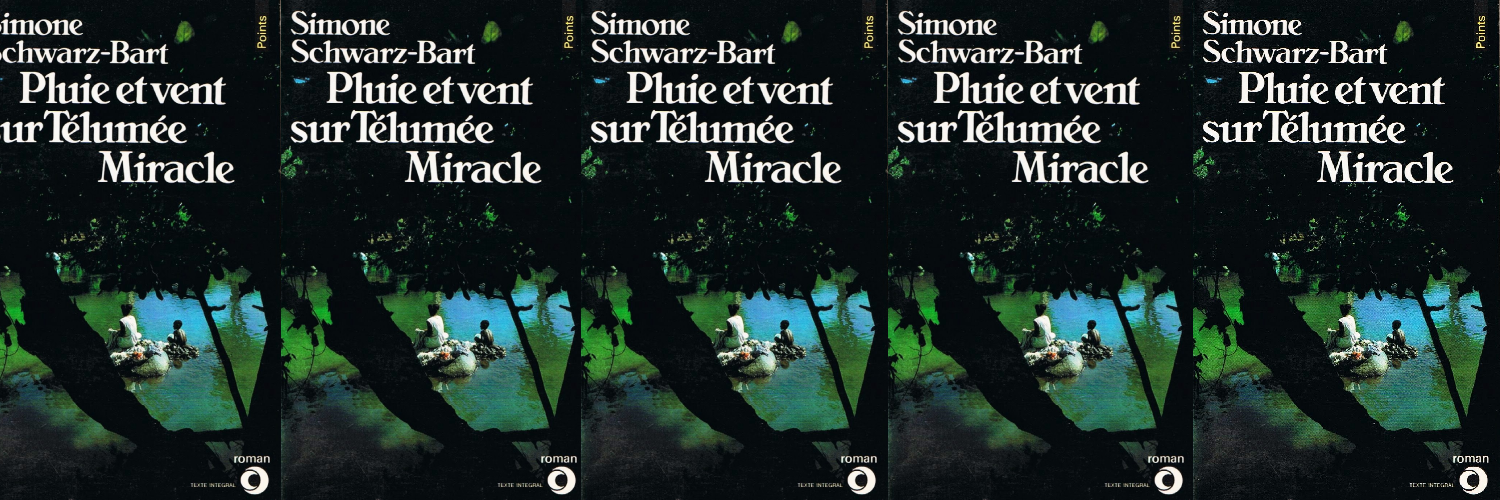
Waves, Emanations: The Bridge of Beyond by Simone Schwarz-Bart
This, my friends, is a book that will pull back a curtain and show you something incomparably lovely, and then while you are gazing at it in awe, punch you in the stomach.
Is that a recommendation? You bet it is. Originally published in French in 1972 as Pluie et vent sur Télumée Miracle (Rain and Wind on Télumée Miracle), The Bridge of Beyond is the story of four generations of women from Guadaloupe, an archipelago between the Caribbean Sea and the Atlantic Ocean. It is narrated by Telumee, and it is primarily the story of her life and the relationship she has with her remarkable grandmother, Toussine—known to the locals as Queen Without a Name.
When Telumee’s mother meets a man, she packs her ten-year-old daughter off to live with Queen Without a Name. For Telumee, it is almost like entering a different world.
As much as Telumee loves Fond-Zombi, life there is hard. Moments of joy and belonging are more than paid for by long stretches of suffering and despair. The Guadaloupe that Telumee lives in has been shaped by generations of slavery, built atop a foundation of violent colonialism (to this day the archipelago is claimed by the French, despite movements for independence). Likewise, those who inhabit this place are shaped by intergenerational trauma and internalized torment.
Make no mistake: parts of this book are hard to read. As Telumee makes her way through life, contending with poverty, hunger, racism, assault, horrific abuse, and the whims of a community that is not always good at taking care of its own, she has moments of questioning her very existence. At times she finds ways to escape her own mind, something that some readers of the book, as well as Telumee’s own narration, describe as “madness.” But to me, this is not madness. This is survival.
Reading this book was like being borne along on waves that sometimes lifted you up with the transcendence of their beauty and sometimes plunged you under with their equally expressive horrors. It was both sobering and thought-provoking to consciously try to shed my modern and privileged sensibilities while reading this.
Outrage at the abuse that Telumee endures made a part of me want to shake her and tell her to get out of there, to save herself. But another part of me realized that it is not that simple—there are many factors at play. The women of Guadaloupe sometimes have to do things that damage their humanity—they might have to submit to white employers who treat them as less than human; to work long days in the canefields, tearing their hands amid the cane splinters in the blazing heat; even to stay tethered to sadism and abuse far longer than they should for the lack of any other options—and to weigh the pain of staying against the pain of walking away from a fellow, beloved, struggling soul. These things are part of the legacy of slavery and dispossession.
But in among the pain there is love and there is a sense of something greater than oneself. Faint traces of magic, or witchcraft, are present, particularly in the character of Ma Cia, who is Queen Without a Name’s friend, and who it is said shapeshifts at will. Ma Cia is the one to whom people go for healing and for cures, and she eventually passes down some of her knowledge to Telumee, who takes up this mantle herself later in life. Queen Without a Name, too, is always ready with a story or a parable to teach her young granddaughter about life—and about that which goes deeper than what we can see.
Her loving and warm relationships with Queen Without a Name and Ma Cia teach Telumee never to give up, never to give in, never to succumb to despair, no matter how hard things get. Queen Without a Name had decided, Telumee tells us early on, that “life was not going to lead her up the garden path”:
It is with this strength that Telumee continues to survive and to carry out her days on Guadaloupe. The story follows her all the way to old age, when she is a village matriarch herself, crowned “Telumee Miracle” by her community. Right to the end, the waves ebb and flow, now content, now uncertain.
Jamaica Kincaid wrote the introduction to the New York Review of Books 2013 edition. She wrote, “Literature like this does not offer the comfort of an already digested plot. It seeks out the truth of history, which turns out to be most powerfully and effectively conveyed through fiction.” It’s true that this book is a chronicle of a life rather than a story that fits a proscribed narrative arc. It’s also true that you can sense Guadaloupe, its landscape and its people, their lives and the way they live them. The Bridge of Beyond draws you in and shows you astonishing things, for better or for worse. It’s worth the trip.
Comments