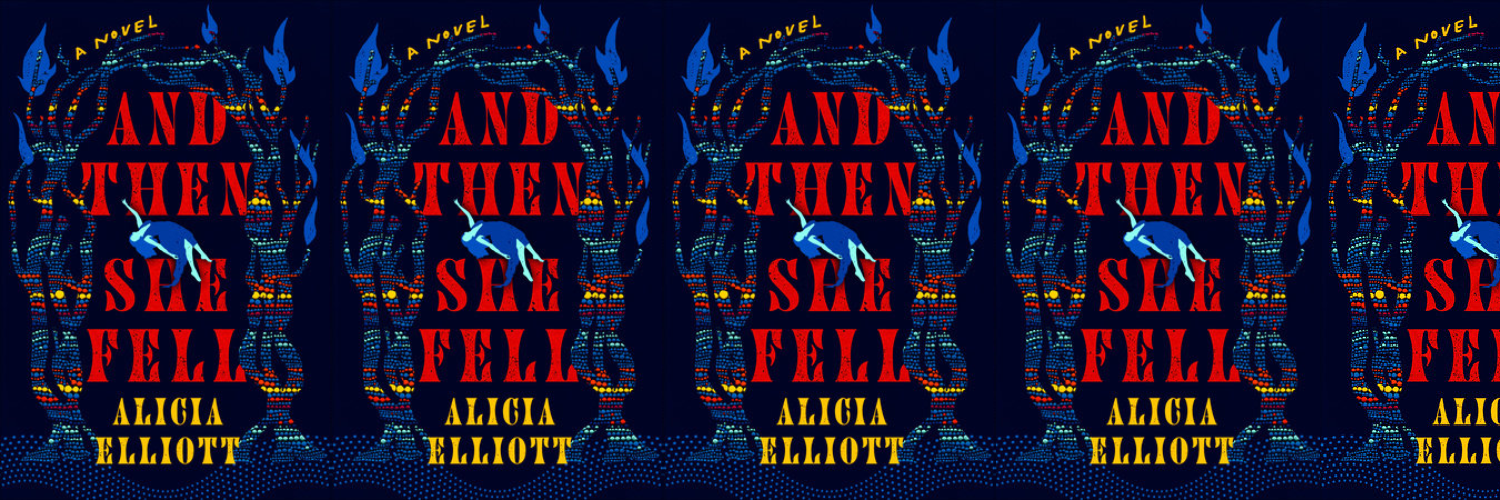
The Thin Line of Reality: And Then She Fell by Alicia Elliott
Poignant, funny, horrifying, moving, smart, enraging, absurd: these are all adjectives that came to mind when I sat down to write this review of Alicia Elliott’s brilliant debut novel And Then She Fell. It’s a quick and intense read, with incredible, chatty, and hilarious chapter titles and a thoroughly amazing prolonged climax that I absolutely will not spoil for you, even though I am dying to write about it.
I’m trying to sum up the tone of this book and I’m not having an easy time of it. In many ways this is a story about trauma, and it never makes light of its characters’ experiences and histories. But its protagonist is so engaging that I wanted to spend time with her; in some ways reading this felt like hanging out with a witty friend—albeit one who was going through some shit.
The story is (mostly) narrated by Alice, a young woman living in Toronto with her new husband and baby. Alice is a Mohawk, or Kanien’kehá:ka, woman who grew up on the Six Nations reserve. Her husband, Steve, is a white settler academic studying Alice’s Mohawk culture and language, and he is working towards tenure at his university while Alice is at home with their one-month-old baby, Dawn. That in itself is pretty enraging, but it is only the tip of the iceberg of what Alice is contending with.
It is A LOT. In between grieving her recently deceased mother, living an isolated life off the reserve and away from her community for the first time and facing daily microaggressions from her white, upper class neighbours, Alice is trying to write a book. It’s a modern retelling of the Haudenosaunee creation story, and it has taken on an impossibly heavy weight in Alice’s mind, because it not only proves that she belongs in this new life with Steve (being a visionary, emerging writer rather than a girl plucked from her job at the bingo hall), but it also has to fulfill her father’s legacy and be powerful and good enough to provide meaning and inspiration to future Haudenosaunee generations.
With so much pressure, it’s a wonder she manages to get a single word down on paper. But even that is not all: strange things have been happening to Alice. She hears and sees things that others do not. Sometimes this means that trees and cockroaches talk to her. Sometimes it means that she has vivid imaginings of violently harming her baby, or that Walt Disney’s Pocahontas breaks script to chat to her through the TV screen and give her warnings. Often it means that there are vicious, sinister things lurking all around, waiting to catch Alice out as an imposter.
As I mentioned earlier, Alice is an extremely likeable narrator—she’s smart, funny, sometimes caustic, always questioning and always self-aware, even when she’s not quite sure where reality and time begin and end. Her experiences are both real and not real, and one of Alice’s challenges is to work out where her true connection to the more-than-human world starts to bleed into harmful delusion.
And Then She Fell complicates overly simplistic narratives of mental health by taking Alice’s experiences with hallucinations and postpartum psychosis and looking at them from a non-Western perspective, considering the possibility that there is more than one valid way of being in the world.
Complicating this even further is the very real experience of gaslighting that Indigenous peoples have to contend with all the time. You only have to be paying the smallest amount of attention to know about the myriad stereotypes, misconceptions, appropriations, denialism, and injustices that contribute to a widespread culture where Indigenous peoples are told “just get over it,” or “it’s not a big deal.” So where exactly is the line between reality and construct, between justified fear and paranoia? It may not be as easy to tell as you originally thought.
Although I am not, in general, a reader of horror books, the genre choice is perfect here. The tropes of horror and terror—menacing atmospheres and rich, sometimes graphic descriptions; supernatural elements and monsters; the Stepford-esque neighbours; and the confusion between what is real and what is imagined—are used to fantastic effect. Alice’s story grips you; turning the pages becomes imperative. The side characters are also fantastic—I loved Aunt Rachel, Dana, Tanya; I hated Steve with a white-hot flame of hatred.
Woven between Alice’s chapters are chapters of the book she is writing—irreverent, funny, pushing back. It is here that we can see a bit deeper into who Alice is when she is at home with herself, even as she second-guesses her words once they are down on paper. The story of Sky Woman—or, Mature Flowers, as Alice calls her—has certain parallels to her own story, something that Alice is not unaware of. Even though we know that Mature Flowers ultimately falls, we don’t know how or why. Did she jump? Was she pushed? Did she slip? The resolution to this question feels important to Alice’s own ending.
I said no spoilers, so I’ll stick to that and end here. But I promise you—this book is not going where you think it is. It’s going somewhere better. Oh, and just one more teeny thing: look out for a character called Pete. I do love him so.
Thank you to Penguin Group Dutton and NetGalley for the complimentary advance review copy.
Comments