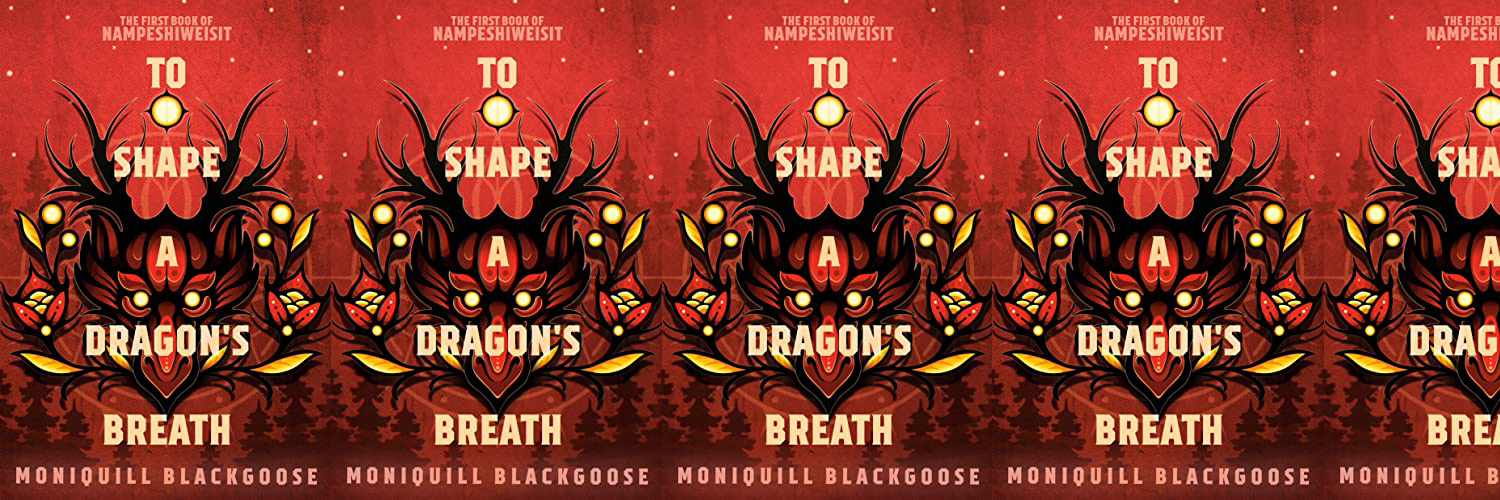
Quiet Moments in Critical Times: To Shape a Dragon’s Breath by Moniquill Blackgoose
Picture this: It’s the 1840s, and the world has been shaped differently by history. Scandinavian colonizers have replaced British ones, magic is real, and so are dragons. Steampunk meets gaslamp fantasy in a world where automata oxen pull wagons and a dragon’s breath has destructive powers that can be shaped and transformed by those skilled in that particular art. Dragons are bred and tightly controlled, their “dragoneers” highly trained and regulated.
Into this world one day comes a dragon that no one has seen for centuries: a Nampeshiwe (nahm-PESH-ih-WAY). Not a dragon that belongs to the colonizing European stock, but a free Indigenous dragon native to North American lands. Only one person sees it: Anequs (ahn-eh-KOOS), a fifteen-year-old girl living on Masquapaug, one of the few Indigenous islands not much interfered with (yet) by the colonizers, because it contains nothing of value to them.
The next morning Anequs finds the egg that the dragon left behind, and her community tends to it as per old tradition. When it hatches, it chooses Anequs to bond with, and she becomes the first Nampeshiweisit (“person who belongs to a dragon”) in generations.
Despite its distinctions from our world, this analogue is not so different that the colonizers can leave this Indigenous community and their dragon alone. And so Anequs, along with her dragon Kasaqua (ka-SAH-kwah), end up at Kuiper’s Academy of Natural Philosophy and Skiltakraft, far from her home and everything she’s ever known. As you might imagine, her ideas are very different from those of the people she meets here, and her strong will means that she does not meekly assimilate the way they expect her too.
To Shape a Dragon’s Breath is beautifully character driven. Its exploration of colonization and the way that cultural worldviews inform belief and action is rooted in its characters: Anequs and her family, her fellow students and teachers, the servants at the school, the politicians and elders—even the dragons. It never oversimplifies things, and it gives you characters that you look forward to spending time with, characters whom you are invested in seeing play out their lives and relationships. The fact that this takes places on a stage where countries might go to war, governments might be overthrown, hate crimes can and do happen—and that it seems quite natural for these things take a back seat to the daily interactions of one 15-year-old girl—is a testament to Moniquill Blackgoose’s skill in showing how seemingly small and inconsequential things have effects that shadow forth into the wider world.
Even though the stakes are high, I found this book a rather soothing read. I really, really enjoy reading about competent characters who do things intelligently and efficiently, with none of the bumbling and misunderstandings that some authors seem to think are necessary for tension in plot. Anequs is deeply competent and level-headed, which was part of the pleasure of this book for me.
Another of the things I found so enjoyable about To Shape a Dragon‘s Breath was its lilting story structure. (If I were to go by Jane Alison‘s nature-based categories of plot, I would call this one wavelets). Although there is progression and forward momentum, and there is tension that builds over time, the story is presented as a linked series of short interludes during one school year. The charming chapter titles underscore this structure (“She Had an Illuminating Conversation,” “Four Acquaintances Went to Vastergot,” “Autumn Came”). In an odd way it reminded me of L.M. Montgomery's 1925 Emily Climbs, which follows its protagonist through her years at college in a similar vignette/wavelet style (spoiler: there are no dragons in Emily Climbs).
One thing I want to note: I read a brief review by Jo Walton, in which (among much praise) she wrote, “But both the heroine and the Indigenous utopia she came from were just a little too perfect to be believable.” I would have to disagree. Anequs’s community is not what I would have called a utopia—it has its challenges, including scarcity during bad harvest years, conflict between family members, disagreement about the best future path, and members who must go away for months at a time for work. At the same time, they survive and thrive because of their tightly knit bonds, oral tradition as a way of passing down knowledge, the aforementioned calm competence, and community resource sharing. To our capitalist disaster of a society this may well look like an unrealistic utopia—but if colonization had not interfered with its development, it does not seem unlikely to me that an Indigenous island community of this type in the 1840s would be something very similar to the community on Masquapaug.
For those who enjoy diving deep into magical systems, satisfyingly competent characters, seasonal rhythms and gentle pacing, challenges to colonial worldviews, and, last but not least, dragons—you will find great joy in To Shape a Dragon‘s Breath. I am very much looking forward to the rest of this series.
Comments