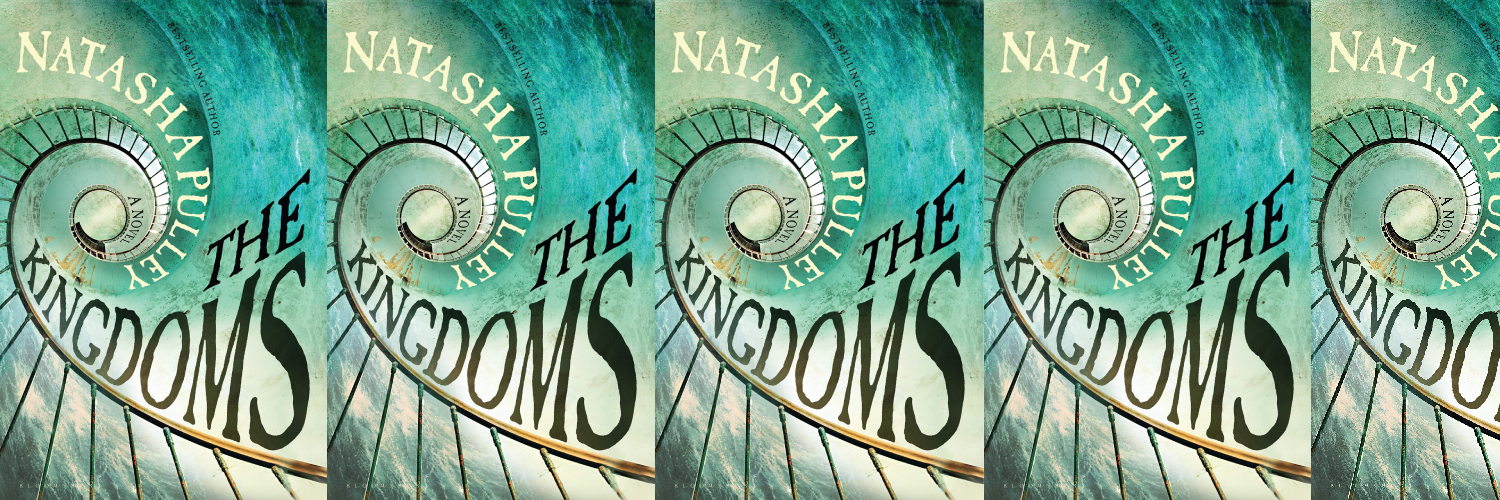
That time Natasha Pulley shattered me into tiny bits and then delicately put me back together again (i.e., I read The Kingdoms)
It’s been a while since I’ve been so emotionally devastated by a book. I realize, in retrospect, that I’ve been doing a lot of comfort reading. Books where, even when bad things happen, I know that a happy ending is guaranteed. I didn’t know of any such guarantee when I started The Kingdoms. I had never read Natasha Pulley before. And I was not prepared for what she was about to do to me.
The Kingdoms is the story of Joe Tournier, who lands on a train platform one day in 1898 Londres, in a world where the French won the battle of Trafalgar and have occupied England. Joe steps off the train and realizes that he has no memories. He knows his name, and general information, but nothing else. His doctors diagnose him with a form of epilepsy that is accompanied by temporary memory loss, déjà vu, and jamais vu.
Joe quickly learns that he is a slave, as many English are in this world, and is sent home to his master and his wife. He tries to settle back into his life, but his memory never returns. And his false memories won’t go away—indeed, they are more real than anything else, from the shadowy man who waits for him by the sea to the elusive “Madeline,” a woman he is sure he knows.
Three months after his memory loss, the postman turns up at the door with a letter. He informs Joe that the letter has been held at the post office for ninety-three years, with instructions to be delivered to him on today’s date. Inside is the front page of a news sheet from 1805, and a postcard with an etching of Eilean Mòr Lighthouse in the Scottish Outer Hebrides.
What comes next is a twisting story that follows Joe to Eilean Mòr and beyond, eventually travelling back in time to the Napoleonic Wars and across the seas on battleships. While he struggles to understand who he is, Joe is plunged into the foggy realm of memories—his own and those of others—and the politics of war-making, where every action he takes could change the future he knows. The one thing that becomes clear is that his identity is entwined somehow with the ruthless but brittle Captain Missouri Kite, and the fates of the crew of the Kingdom, a ship that strayed from its course a hundred years ago and ended up lost in time.
My immersion into this book was gradual. The first thing I noticed was Natasha Pulley’s incredible use of evocative detail. Her prose is scattered about with such sensory specificity that is hard to imagine she did not herself live in a London sooty with steelworks, or in a wintry, haunted lighthouse, or on a battleship at the turn of the nineteenth century.
Because of this detail, the images are strong and they linger in your mind—from the sudden arrival of winter in a swift line of ice that sweeps across the sea, freezing a laughing girl’s wedding veil that trails behind her as she runs ahead of the frost; to the flower pattern showing through the indigo dye of the doctors’ dresses; to the hissing of the brooms on deck after battle, redly pushing pieces of people overboard. The world that the book creates feels so real that you might be able to walk into it. Joe’s disorientation is your own as you get pulled into an unfamiliar and immersive world.
The next thing I noticed was the how skilfully and thoroughly the characters were drawn. Joe’s warmth, even in the face of amnesia and hopelessness, is steadfast. His kindness towards others is rendered in the way he is always asking if people are okay, always trying to put people at ease when he can, his penchant for leaning into a person reassuringly, the way he plays with and talks to his infant daughter. Kite is drawn with a little more complexity, and his contradictory actions—oscillating between cold mercilessness and gentle, wry vulnerability—become clear as layers are revealed and we see the endless traumas of his life, what he has lost, what it takes to keep going, and his bone-deep fragility.
This is a time and place where acts of brutality are, of necessity, also acts of kindness. The Kingdoms does not shy away from the tolls of battle and there is no glorification of empire here. Instead, there are people who have been forced to live in such a way that parts of their humanity must be sacrificed in order to save the people they can.
The next thing I noticed was how all of a sudden I would have died for Missouri Kite and Joe Tournier and if they weren’t going to be okay then I wasn’t sure what I was going to do.
Then, at last, I noticed my own response changing, and the thought emerging: What is a happy ending, anyway? By the time we get to the end of Joe’s story, everyone has suffered so much and lost so much that there is no way that everything can be recovered. We were leaving these people damaged, one way or another. The only question was, would that unbearable thread of tenderness woven throughout the story prevail?
I'm afraid I can’t tell you that. You’re just going to have go on this journey yourself.
Comments