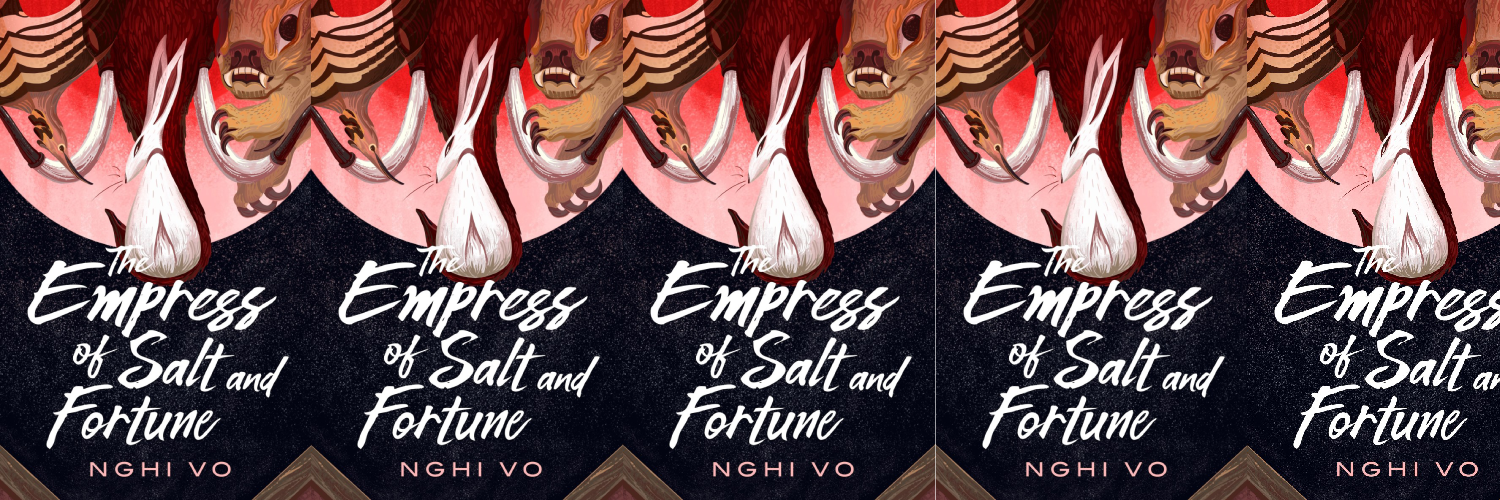
Come for the Intrigue, Stay for the Impeccability: The Empress of Salt and Fortune by Nghi Vo
In an abandoned royal compound surrounded by haunted birch barrens and a glowing lake, an old peasant woman spins stories. A young cleric listens, and writes records. A magical bird listens, and remembers.
The Empress of Salt and Fortune by Nghi Vo is a small and perfectly spare novella. In spite of its brevity, it hums with intrigue, pain, and beauty. The story begins when Chih, a cleric from the abbey of the Singing Hills, and their mystical neixin companion Almost Brilliant (who is a hoopoe with a perfect memory and the ability to speak), receive word that areas previously under imperial lock are now declassified. Chih and Almost Brilliant are headed to the capital for the first Dragon Court of the new empress, and they happen to be close to one of these areas—Lake Scarlet, which is situated at the old empress’s compound. They cannot resist making a detour, and being the first to discover what stories there are to find.

What they find in the compound is Rabbit, an elderly woman who was sold to the imperial court at age 5, and who went on to become handmaiden to the Empress In-yo. Over the course of several days, Chih discovers items tucked away in the compound and makes records of them. Rabbit observes them, and tells them the tales belonging to each item. Slowly these tales weave into a bigger picture of the Empress In-yo, her arrival as a young woman at court, her marriage to the cruel Emperor Sung, her exile, and her eventual return six years later.
Rabbit’s story is a political thriller to rival the best of them, and Empress In-yo is a formidable player—clever, cunning, passionate, quick. This is a world where girls and women are nothing more than possessions to be kept or discarded at whim. I loved the quiet way that this book manifested its feminism. Atrocities committed against the female characters are spoken of matter-of-factly. They are not belaboured, nor are they excused; they both are and are not what the story is about.
The story is discovered in the everyday objects of a woman’s life as Chich uncovers and catalogues them— a sleeping robe, a dice game, a broom with a broken handle, a box of spice. These things, like the women who owned them, were easy to overlook and underestimate. The descriptions in The Empress of Salt and Fortune are lovely and elegant. The book has a delicate feel to it, perhaps because of the way Chih handles each item that they uncover, with gentle hands and precise descriptions.
Another delight is the sense of place, which is beautifully wrought, from the rooms of the compound to the ghostly barrens to the inexplicable lake. Subtle details also portray relationships—between In-yo and Rabbit, between Rabbit and Chih, between Chih and Almost Brilliant. I loved the evocative place names, from Singing Hills to Thriving Fortune to the Palace of Gleaming Light. I loved reading about Rabbit and Chih brewing tea or eating rice flavoured with birch water. The frame story is so much more than just a frame in this novella. It is essential scaffolding, equal to the story that Rabbit is telling.
I won’t say too much about the story that Rabbit ultimately spins for Chih; I don’t want to ruin it. If you are looking for a quick read that will transport you, for a story with not a word out of place, then this is the book for you. Nghi Vo has continued her tales of the wandering scribe Chih in the Singing Hills cycle; as far as I know, the series ongoing. Lucky for us.
Comments