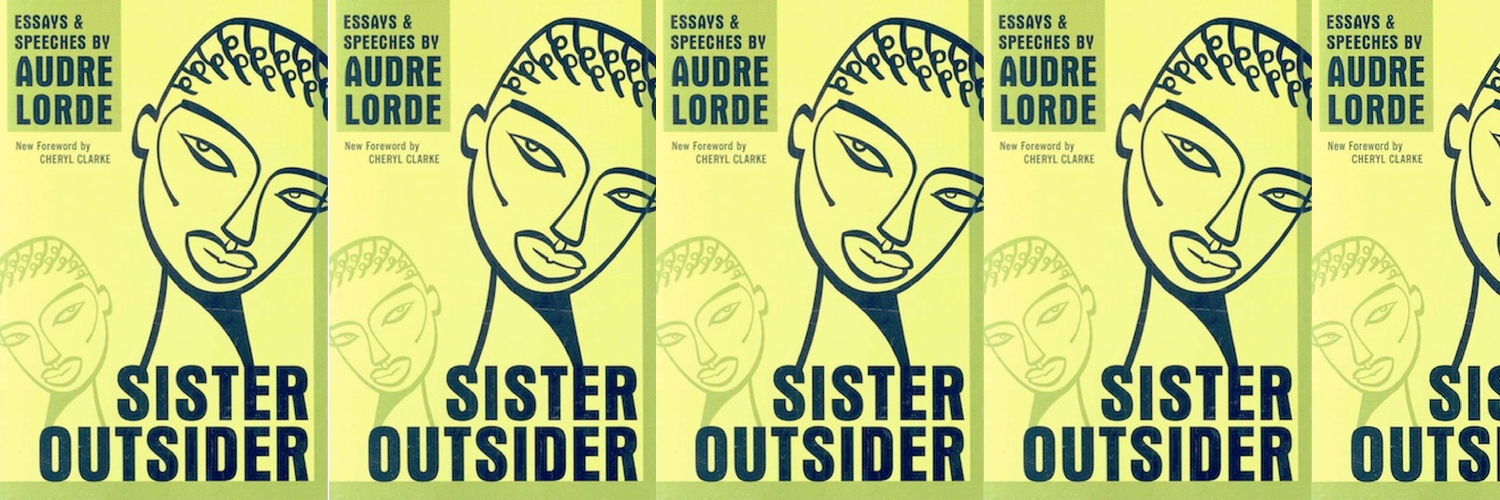
Careful Attention: Sister Outsider by Audre Lorde
March is here. It came in like a race between the lion and the lamb…yesterday we alternated between glorious sun and blue sky, and wild squalling blizzards. Today is grey and cold; when I tried to let my cats out, they blinked in the frigid air, flicked their paws, and went back to bed. I can't say I blame them. The mid-winter blues are upon me, with a side of pandemic to boot.
Thank heavens for books.
I’ve been doing lots of reading lately—some for work, some for pleasure. (And to be honest, even the ones for work are still for pleasure.) But today I wanted to write about the most powerful book to have left its impression on me lately: Sister Outsider by Audre Lorde.
This is a book of collected essays and speeches, and while various pieces in it have been an inspiration for a long time, this past month I finally sat down and read it cover-to-cover for the first time. And while I’m a little on the fence about marginalia, I confess that I did a lot of underlining and asterisk-ing and curly bracket-ing while I was reading it. There is just so much good stuff in there!
And in all honesty, part of me was a little nervous to write about this book. Audre Lorde writes with strength and thoughtfulness and insight about so many issues that I will never experience myself. Her experiences with racism, homophobia, and classism are not something that I have to contend with. Who am I, I thought, to contribute my thoughts about her work?
But knee-jerk reactions like that would have disappointed Lorde. One of the recurring themes across these pieces is the need to acknowledge and honour and respect all of the multitude of differences that exist between people. She draws our attention to the ways in which Western European history has created the illusion that difference is equal to a simplistic binary of superiority/inferiority. She says:
Which is not to say that it is up to Black woman, or any other marginalized group, to educate others. We know this, and Lorde is very clear about it: “Oppressed peoples are always being asked to stretch a little more, to bridge the gap between blindness and humanity,” she writes. It’s remarkably on the nose for 2021, as so many activists are still having to repeat this sentiment (Sister Outsider was published in 1984). She also writes, “Frequently, when I am talking to men and white women, I am reminded of how difficult and time-consuming it is to have to reinvent the pencil every time you want to send a message.”
Sister Outsider is an unflinching look at racism, sexism, classism, homophobia, ageism, and patriarchal oppression. Writing in an era before the term intersectionality had been coined, Lorde draws our attention to the realities of unacknowledged differences. “There is a pretense to a homogeneity of experience covered by the word sisterhood that does not in fact exist,” she writes.
The essays span across subjects such as anger, silence, motherhood, poetry, eroticism, and community. Lorde’s prose is strong; these are clearly the words of a woman who has spent much time reflecting, challenging herself, and working hard for change. She speaks of reading the words of Malcolm X “with careful attention,” and she seems to do everything that way. When she writes, “What woman here is so enamoured of her own oppression that she cannot see her heelprint upon another woman's face?” you can tell that she has interrogated herself as deeply as she is inviting you to do. “Change means growth, and growth can be painful,” she says. Painful, but necessary.
In a particularly powerful essay about silence, she talks about confronting her own mortality upon learning that she needed surgery to remove a possibly malignant tumour:
There is just so much to learn from and enjoy in this book. In addition to its deep exploration of the violence that exists in the world, and the crucial cultural and societal changes that are needed and how they might be worked towards, it also has some glorious passages about writing poetry, including the essay “Poetry Is Not A Luxury,” and the interview between Lorde and Adrienne Rich.
I urge everyone to read this collection. Audre Lorde’s intellect, insight, and wisdom were vast, but so was her heart. I can’t imagine anyone reading it and not wanting to try harder, to do better, to look at themselves and ask the tough questions. Because as much as anything, this collection is a call to action:
Comments